
Respiratory equipment
How to choose an oxygen concentrator: continuous flow and pulse dose
Author: Oleksii Pavlov, CEO of MedBoom
When a doctor has prescribed oxygen therapy, choosing a concentrator starts with checking that it matches the prescription. Weight, a battery and a convenient handle matter, but first you need to establish which oxygen delivery method you personally require. This article will help you prepare questions for your doctor and supplier. It does not determine treatment indications, settings or duration of use.
Clarify the prescription first
Home oxygen is used on the prescription of a medical professional. Buying a device yourself does not replace an assessment of your condition and selection of therapy. The NHS emphasizes this.
Before comparing models, ask your doctor to clarify the delivery method, conditions of use and whether a separate assessment during movement or sleep is needed. If the prescription contains only a number, do not try to guess what it means. The seller needs an unambiguous technical requirement, and the user needs a clear explanation from a medical professional.
Record medical requirements and everyday preferences separately. The prescribed mode belongs in the first group. Transportability, ease of operation, installation location and access to servicing can be included in the second. This list helps prevent an attractive extra feature from taking the place of the main requirement.
Continuous flow and pulse dose
With continuous flow, oxygen is delivered at a constant rate, including between breaths. A pulse-dose system delivers a separate dose linked to the detection of an inhalation. These are different operating principles, so matching numbers on the control panels of different devices cannot automatically be compared. The Pulmonary Fibrosis Foundation explains the basic difference.
For example, the manufacturer of the Inogen Rove 6 explicitly states that pulse-dose settings are not equivalent to liters per minute. Settings on one device may also not correspond to those of another model. Source: official Inogen Rove 6 user manual.
A pulse-dose level should therefore not be transferred from one concentrator to another or interpreted as a continuous-flow rate. If a device needs to be replaced, the suitability of the new model must be confirmed before use begins. Do not choose a mode solely from descriptions such as “for home use,” “portable” or “for walks.”
How to compare models without confusion
Create a short record for each candidate. Include the exact name, version, delivery type and a link to the instructions for that specific version. Ask the supplier to show where the required mode is described in the documentation. A verbal answer not tied to a specific product leaves too much uncertainty.
Next, compare practical considerations:
Can the person comfortably read the display and use the buttons?
Which power sources are provided for the specific configuration?
What is included in the delivery, and what must be ordered separately?
Who will explain the device's alerts and care instructions?
How are warranty and post-warranty servicing organized?
Do not judge battery runtime by the largest number in an advertisement. Clarify which battery was used and under what conditions the figure was obtained. Ask for a written description of the package so that you compare equivalent sets, rather than one seller's basic device with another's expanded package.
What to establish before payment
Discuss a plan for a power outage or malfunction with your doctor and supplier in advance. HSE recommends providing a backup oxygen source for these situations. The specific backup and procedure for switching to it must match your care plan. Source: HSE guidance on home oxygen.
Also ask for an explanation of first-time setup, obtaining consumables and contacting the service provider. Keep the instructions, purchase documents and contact details of the responsible specialists together. If a family member or other close person will help you use the device, include them in the training.
Before ordering, ask a final checking question: has this exact model been confirmed as matching the prescribed delivery method? If the answer is unclear, seek clarification again. A well-prepared selection starts with agreed requirements and ends with a clear plan for use, not just delivery of a box.
Models for a specific discussion
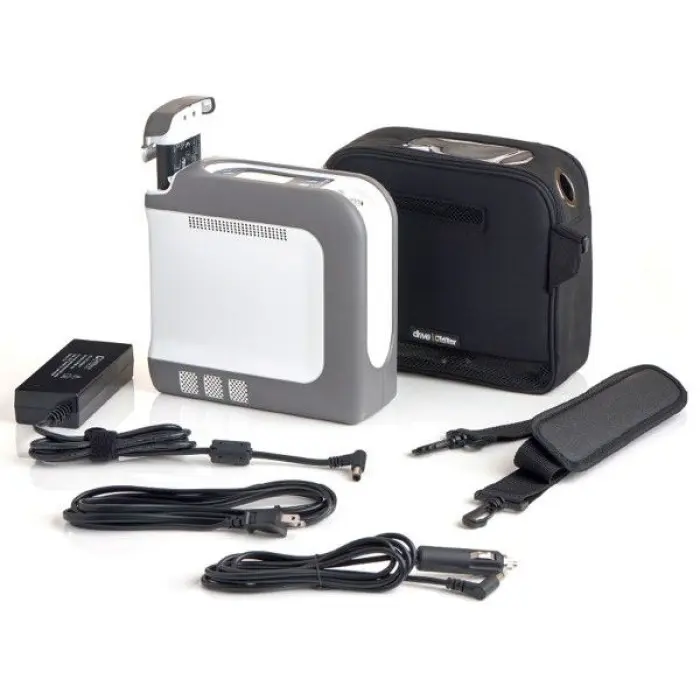
In the MedBoom catalog, you can view the DeVilbiss iGo2, Inogen Rove6, DeVilbiss 525 and DeVilbiss 1025. These links are for learning about specific products, not a list of interchangeable solutions. Check the selected model and its package against the prescription and instructions before purchase.